In March, I started a piece I never published. I haven't written anything in six months, for that matter. It began with an image and a research paper.
The paper came out of one of the most prestigious business schools in the world: the Wharton School at the University of Pennsylvania.
Researchers asked thirteen hundred people to solve small logic problems, the kind where the first answer that comes to mind is wrong and you need ten more seconds of thought to get it right. Some of the participants had access to an AI assistant. Sometimes it gave the right answer; sometimes it gave a wrong one.
When the assistant was right, people did better. When it was wrong, they followed it into the mistake and their accuracy dropped. It fell below that of participants who had no help at all.
The researchers called this "cognitive surrender." You stop working it out yourself, because you know the answer will come from outside. You go with whatever a system that speaks with confidence tells you.
What struck me most wasn't that number. It's that participants' confidence in their own answers rose across the board. Access to a voice that sounds sure of itself doesn't make the answers any better. It just makes people more confident, even when they're wrong.
The image is a meme posted by the official account of the U.S. presidency six days after the first strikes on Iran.
That day, Pokémon Pokopia came out, and its box art, a Pokémon village seen from above, became the template for thousands of edits. The White House made its own: its logo in one corner and, across the top, in rainbow letters, "MAKE AMERICA GREAT AGAIN."
The same week, edits made for social media began circulating. Airstrike footage was cut together with film clips: Tropic Thunder, Top Gun, Iron Man and Braveheart, under the title JUSTICE THE AMERICAN WAY. The next day, the same thing was done with a clip from the video game Grand Theft Auto, and the word WASTED appeared after each impact — the word the game displays when your character dies.
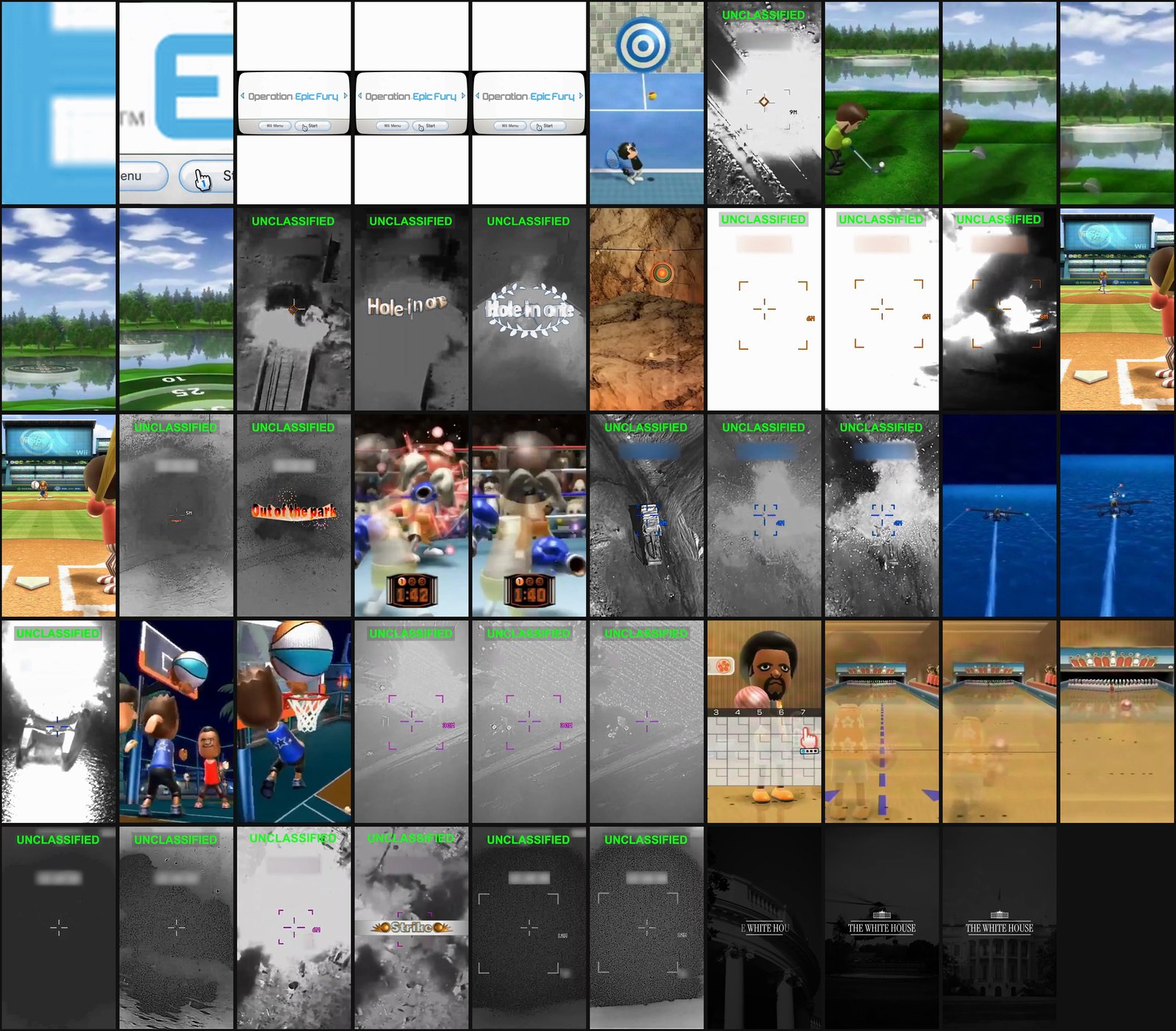
Then SpongeBob, Call of Duty, the NFL... On March 12, after The Pokémon Company said it had given no permission, a video cut to Wii Sports, with the game's original music and the caption UNDEFEATED, passed a hundred million views.
The actor and director Ben Stiller asked, in a post on X, for Tropic Thunder to be taken down. "Hey White House, please remove the Tropic Thunder clip. We never gave you permission and have no interest in being a part of your propaganda machine. WAR IS NOT A MOVIE."
The same week, accounts close to Tehran were pushing AI-generated videos: a Lego Trump, a Teletubbies Trump, an Iranian jet facing down an American warship, seen seven million times, and a deepfake of a fire aboard the aircraft carrier USS Abraham Lincoln that the American president at first took to be real. The Lego series comes from an account called Explosive Media, which switched from Farsi to English on March 7. It drew a hundred and forty-five million views in three weeks. The audience wasn't in Iran: less than five percent of the views came from Iran or Russia. Anti-Trump protesters picked it up for their marches. The account acknowledged that Tehran was a "customer." This campaign helped coin the term "AI slopaganda" — mass propaganda, generated fast, by AI.
In my March draft, I had stopped at Stiller's reply. It was right, and it was useless.
What did these images produce, over six months, on either side?
Harun Farocki devoted part of his life to a single question: what do images do when they are no longer there to show?
In Bilder der Welt und Inschrift des Krieges — Images of the World and the Inscription of War — he goes back to aerial photographs taken by the Allies in April 1944 over Silesia. The analysts were looking for a fuel plant. They found it, measured it and annotated it. On the same photographs, a few centimeters away, were Auschwitz, its barracks, its ramps and its crematoria.
Nobody saw them.
Not because they were hidden, but because nobody was looking for them. The image held the camp; the eye held a factory.
Later, in Eye/Machine, Farocki showed footage from a missile's camera in the seconds before impact. The weapon and the camera are one. It isn't an image of destruction, but destruction itself, seen from the inside. He called this an "operational image": an image not meant to show, but to act.
The GTA video belongs to that category. The strikes are real, the WASTED sequence comes from a video game. Put together, they make an image in which real death and death in the game are spelled the same way. It isn't a lie. It's an apparatus.
The village of Pokopia looks like a map.
In the late 1990s, John Hanke founded Keyhole EarthViewer 3D, the first software to stitch satellite images and aerial photographs onto a three-dimensional globe.
In-Q-Tel, the CIA's investment fund, put money into it, then adapted it for the war in Iraq in 2003. Google bought it the following year and renamed it Google Earth. John Hanke stayed at Google, then founded Niantic, which released Pokémon Go in 2016.
Since 2021, players have been using their phones to scan the streets, parks and landmarks where they play. Some thirty billion scans so far, which a subsidiary, Niantic Spatial, is turning into a three-dimensional map of the world, close up and at eye level.
In a press release, Hanke explained that making Pikachu run down a real street and guiding a robot down that street are the same technical problem. He was talking about delivery robots.
In December 2025, Niantic Spatial partnered with Vantor — formerly Maxar, which supplies satellite imagery to the U.S. military. Their product combines Niantic's ground-level map with aerial navigation software so that a drone can find its way when GPS is jammed.
Since Ukraine, that has been the first problem any drone runs into. In March, in the Strait of Hormuz, the jamming was so heavy that tankers showed up on navigation screens several kilometers inland.
Iran runs into the same problem and solves it with off-the-shelf parts. Its Shahed drones carry a Jetson Orin, a small Nvidia computer that sells for as little as 249 dollars, along with a thermal camera. Nvidia doesn't sell it in Iran or Russia, but it isn't covered by the strict export controls that apply to data center chips.
The module recognizes the target and guides the drone over the last few kilometers. The Iranian army claimed a strike of this kind on Ben Gurion airport on March 21.
The same module turns up in Ukraine. Russia builds the Shahed under license, and Ukrainian investigators have found the Jetson Orin in four families of Russian weapons, including a Shahed recovered near Sumy in June 2025.
On August 24, the New York Times published an investigation into a Russian drone strike in Zaporizhzhia on July 6. The operators had programmed the drone to fly toward a gas station; the final target was chosen on board by a classifier, software trained to recognize certain objects. It most likely recognized propane tanks. It hit a wall before reaching them. Three people died, including a nineteen-year-old student. It is the first documented case of civilians killed by a drone that chose its own target.
The software was looking for propane. The analysts of 1944 were looking for fuel. The difference is that in 1944, there was someone there to miss it.
In June, a Dutch newspaper asked Vantor whether players' scans were being used to guide drones. Vantor replied that it did not use that data, without saying whether the model had been trained on it earlier. Niantic Spatial acknowledged that the scans had gone into an early version of the system.
A researcher at Delft University of Technology pointed out that the question has no answer: once the scans are folded into a model, there is no tracing where they came from.
So the player will never know whether what they scanned ended up guiding something.
On July 3, 1988, in the Strait of Hormuz, the American cruiser USS Vincennes shot down an Iran Air Airbus. The plane was climbing along its usual route. The ship's defense system, the most advanced of its day, identified it as a fighter in attack profile. The inquiry spoke of "scenario fulfillment": the crew saw what they expected to see. Two hundred and ninety dead. The captain was decorated.
On February 28, 2026, in the first hours of the war, American missiles hit a girls' elementary school in Minab. More than one hundred and fifty dead, including one hundred and twenty children. The school stood next to a Revolutionary Guards complex, from which it had been separated in 2016, as satellite images showed. The database used for targeting was out of date. An American official cited outdated coordinates.
The UN report released recently says the failure to update and verify goes beyond mere negligence.
In the days that followed, everyone had their image of Minab before knowing the facts: a fake confession by the Guards went around, the American president first blamed Iran, Iranian television showed the funerals. The facts came later, first through an internal American inquiry in March, then through the UN in September.
In 1944, the analysts had the camp in the photograph and didn't see it: they were looking for a factory. In 1988, the crew of the Vincennes saw a fighter because the screen showed one. In 2026, the targeting database still listed a military complex at that address, and nobody went to check. Each time, people believed what was in front of them. There were just fewer and fewer people there to see it.
A targeting database is a map. What Niantic sells is a map. One was ten years out of date, the other is accurate to the centimeter, and the problem is the same in both cases: a map doesn't need to be wrong to kill. It only needs to speak with confidence.
When the photographs of the Minab funerals went around, people asked AI assistants to check what they showed. Gemini replied that they showed the aftermath of the 2023 earthquake in Turkey. Grok replied that they showed Covid victims in a cemetery in Jakarta. Without being asked, these tools did what the GTA edit did: they made the image impossible to judge.
In March, I wrote that the irony of internet forums had made its way into government messaging, and that outrage was useless against it, because it was expected in advance and thrown back.
These videos aren't aimed at the enemy. They're aimed at people who get the reference — who have played GTA, who know what WASTED means. The meme convinces no one. It signals: we're on the same side, we share the same codes. It works like a guild, a language that only means something to insiders. The hundred million views of Wii Sports don't measure support for the war; they measure the number of people who looked without seeing.
On the other side, the Lego and Teletubbies deepfakes play the same role for the opposing team. With one difference: the Lego campaign reached people who don't follow the news, and a fringe of American public opinion took it up. A guild recruiting another. On each side, there is a community being offered something to share while the war goes on elsewhere.
On March 12, when the Wii Sports UNDEFEATED video was posted, the Pentagon's inquiry had already concluded that the missiles at Minab were American Tomahawks.
Meanwhile, the war was happening elsewhere.
In March, it played out in the Gulf. Missiles struck Ras Tanura, Saudi Arabia's largest refinery. The kingdom cut its output by a fifth. By the end of the month, a barrel was worth 118 dollars.
In September, the action has moved to the straits and to bank accounts. The Houthis take Mocha, the island of Perim and the Hanish Islands. They now hold the Bab el-Mandeb strait, through which 12% of world trade passes.
Drones have hit the East-West pipeline that crosses Saudi Arabia to the Red Sea and carries four to five million barrels a day, a twentieth of world supply.
Aramco warns European refiners that they will get no crude next month. In France, diesel is at 2.40 euros, and there are calls to go back to the roundabouts.
No edit can do anything with that. Not WASTED, not the Lego. You can't put music over a closed strait. An empty pharmacy in Tehran and an empty gas station in Rotterdam.
So what did these images produce, over six months? Which one acted, the images or the balance of power? Neither, not the way we expected. Stiller was ignored, as expected.
Everyone found what they were looking for. The White House found a hundred million views. Tehran found more. The targeting database found a military complex at the address of a school. The classifier on the Russian drone over Zaporizhzhia found propane.
Everyone looked and nobody saw anything.
The answers were worse, but they come with confidence.